
Marcus Aurelius and the Canadian Problem of Power
How Marcus Aurelius Explains Canada’s Crisis of Leadership

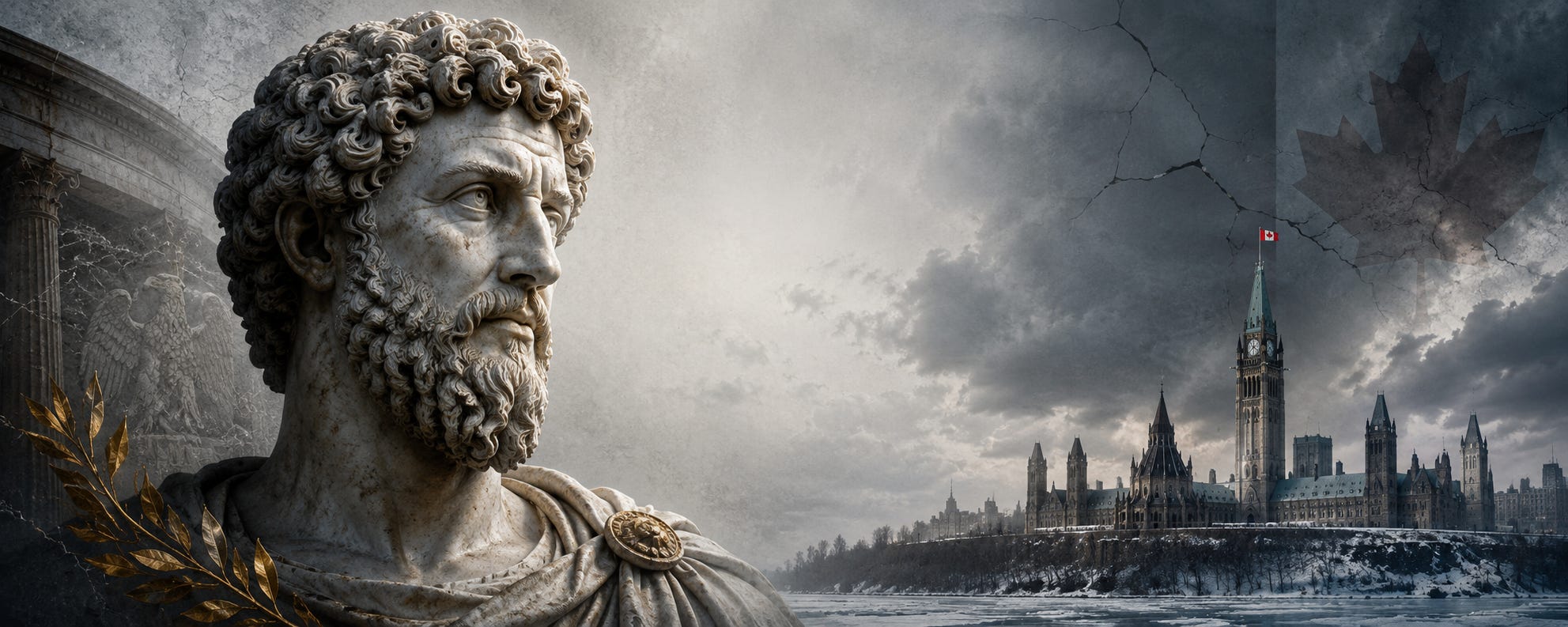
Marcus Aurelius was not sitting in a quiet cottage, sipping tea, journalling beside a tasteful bookshelf, and wondering whether life had “meaning.” Nice work if you can get it.
He was emperor of Rome during war, plague, frontier pressure, political strain, and the daily grind of holding together a massive, restless empire.
That matters.
Because Meditations is not coffee-shop Stoicism. It is not decorative wisdom for people with too much leisure and too many throw pillows. It is battlefield philosophy. Administrative philosophy. Exhausted-man-trying-not-to-become-a-monster philosophy.
And frankly, Canada could use a little of it.
We are not Rome, despite Ottawa’s occasional imperial fantasies. But we do face a familiar problem: power without enough self-command. Institutions without enough humility. Leaders who talk constantly about compassion while avoiding duty, restraint, and consequence.
Marcus understood something many modern politicians seem to forget:
Power does not make you wise.
Status does not make you good.
Good intentions do not cancel bad judgement.
Rome was enormous, wealthy, powerful, and fragile. It stretched across peoples, languages, religions, customs, and competing interests. That scale forced Marcus to think beyond tribe, faction, mood, and personal comfort.
Canada faces a softer version of the same problem. We are a large country with deep regional divides, different economies, different histories, different cultures, and wildly different costs imposed by federal decision-making.
A policy that sounds noble in downtown Ottawa can hit a farmer, trucker, oil worker, small business owner, or northern community like a tax collector with a philosophy degree.
Marcus would have understood that. Not because he was “inclusive” in the modern slogan sense, but because he believed leadership carried moral obligations beyond personal preference.
His thinking gives us four useful lessons.
1. Order beneath chaos
Marcus lived through plague, war, betrayal, death, and endless public duty. He had every excuse to become cynical. Instead, he kept returning to a basic Stoic question:
Is the universe governed by reason and order, or is everything just atoms bouncing around?
His answer was brutally practical:
Either way, behave well.
If there is order, do your duty.
If life is brief and chaotic, do not waste it being petty, vain, cruel, or afraid.
That is a useful Canadian lesson.
Too much of our politics now runs on panic. Climate panic. Pandemic panic. Housing panic. Identity panic. Trump panic. Media panic. Every issue becomes an emergency, and every emergency becomes an excuse to expand control.
Marcus would not have denied problems. He was not naïve. But he would have rejected emotional stampedes dressed up as wisdom.
The Stoic question is not, “How do I sound morally superior?”
It is, “What is my duty, and what does reality require?”
That one question would improve half the press conferences in this country.
2. Humanity is not a slogan
Marcus ruled over strangers. Soldiers. Merchants. Senators. slaves. Provincial subjects. People he would never meet, but whose lives were shaped by his decisions.
That widened his moral frame.
Stoicism taught that all rational beings share in reason. Marcus applied that personally and politically. Humanity was one family, but not in a soft, sentimental, bumper-sticker way.
He knew people were irritating. Selfish. Foolish. Dishonest. He says so plainly.
His conclusion was not, “People are wonderful.”
His conclusion was harder:
People are flawed. Serve them anyway.
That is disciplined responsibility, not cheap compassion.
Canada needs more of that. We have too many leaders who love “humanity” in the abstract but seem annoyed by actual citizens. Especially citizens who drive trucks, work in resource industries, question fashionable policies, own small businesses, or live outside approved postal codes.
The test of public service is not whether you can cry on command in front of a camera. The test is whether your decisions make life more workable for ordinary people.
Food. Housing. Energy. Safety. Work. Community. Freedom of conscience. Fair treatment under law.
That is not glamorous. Good. Government should not be theatre.
3. Virtue is the thing power cannot give you
Marcus had wealth, status, armies, guards, palaces, and fame.
And yet Meditations keeps saying the same thing:
None of that makes you good.
Virtue does.
For Marcus, virtue meant justice, courage, self-control, wisdom, patience, honesty, and duty. Rome could give him command over others, but only philosophy could help him command himself.
That is the missing piece in modern politics.
We talk endlessly about systems, narratives, privilege, messaging, optics, and stakeholder engagement. Fine. Some of that matters. But none of it replaces character.
A leader without self-command becomes dangerous. Not always dramatically dangerous. Sometimes just smug, wasteful, evasive, and insulated.
Luxury rots judgement. Flattery rots judgement. Ideology rots judgement. Bureaucratic distance rots judgement.
Marcus knew the emperor needed laws inside himself. Canada’s leaders need the same thing.
Not another ethics commissioner report after the damage is done. Not another consultant’s slide deck. Not another slogan about values.
Actual restraint.
Spend less than you want.
Tell the truth sooner than is convenient.
Do not punish dissent.
Do not confuse criticism with hatred.
Do not treat taxpayers as livestock with debit cards.
Simple stuff. Apparently revolutionary now.
4. The individual belongs inside a larger whole
Marcus often thinks in terms of wholes and parts. A hand is part of a body. A citizen is part of a city. A person is part of humanity. Humanity is part of nature.
This was not abstract metaphysics. It was moral discipline.
If you are part of a whole, your job is not to inflate yourself. Your job is to function rightly within that whole.
Canada badly needs this reframe.
Rights matter. Individual freedom matters. But freedom without duty becomes childish. And collective duty without individual freedom becomes authoritarian.
The Canadian balance should be simple:
Citizens owe the country responsibility.
The state owes citizens restraint.
Institutions owe the public competence.
Leaders owe the truth.
When any one part forgets its role, the whole starts to wobble.
That is where we are now. Too many institutions demand trust while avoiding accountability. Too many politicians demand sacrifice while protecting themselves from the consequences of their own policies. Too many activists demand compassion while showing contempt for working people.
Marcus would have seen the danger immediately.
A society cannot run on ego, performance, and moral theatre forever. Eventually reality sends the invoice.
The Canadian lesson
Marcus Aurelius was not a dreamy philosopher-king. He was a tired ruler trying to keep his soul intact while the world kept demanding pieces of it.
That is why he still matters.
He reminds us that leadership is not self-expression. It is not branding. It is not emotional performance. It is duty under pressure.
Canada does not need leaders who merely sound compassionate. We need leaders who can govern themselves before they govern others.
Accept reality.
Do the work.
Tell the truth.
Serve the public.
Guard your character.
That was Marcus’ answer.
It would be a good start for Ottawa, too.